Showing posts with label musings. Show all posts

Wednesday, January 19, 2011

Wire

Gotta love them tooths....
I like to fish for fish that have serious teeth. Predators with bite as it were.  To be able to successfully fish for these fish you need to do something to protect your tippet from their teeth. There are several options:

1-    Use wire bite tippet.
2-    Use hard nylon bite tippet
3-    Use fluorocarbon bite tippet
4-    Don’t do anything and hope for the best.
See the wire?  Use the wire.... jackass...
Now, unless you are a complete moron, you will opt for 1-3. I know of one jackass who almost always opts for number 4. He lands about 50% of the pike he hooks which means that he potentially kills 50% of the pike he puts a fly into. Yea, the fish might be able to get the hook out or it could rot away, but why take the risk? No question it is unavoidable to leave flies in fish from time to time. They fight hard and will occasionally break off. It happens. But to start off with no protection from bite offs when intentionally targeting toothy fish like pike is just not good practice or ethics. The best part about this guy?  He guides. Tells you all you need to know about him doesn’t it?

Well, what do I use to prevent bite offs? I have used wire for years and it works. I have tried hard nylon and had some success, but I will take wire over it. I have heard a lot of good things about fluoro and I intend on trying it this year. I guess it is the price that has kept me from trying it out until now. I have used a variety of wire over the years, from single strand to plastic coated and the new multi-strand knotable wire. I definitely have my preferences! I liked the single strand stuff in it’s simplicity but it kinks pretty easily and the large loops that it need to be stored in makes it less practical for a wading or canoe bound angler. And it isn’t as easily available. I have used mostly the latter two for the past few years.
"I thought it was a frog.... seriously..."

Most brands of both the coated wire and multi-strand are fairly similar to one another. I really like the new low diameter knotable wire. Great stuff to work with. I just wish it wasn’t so expensive. $1 foot is a bit steep. I love to use it for topwater flies though. I like the reduced weight in those situations. What is on my leader most of the time now is Climax wire. I have used this stuff a great deal over the past 15 years and it has not let me down. It is inexpensive, widely available and easy to use. If I have to clip off the wire I have on because of kinks or twists I don’t feel like it has cost me a ton of money by the end of the day. And I am more likely to change the wire when it needs to be changed.

Another material I found last year that I really like is called Beadalon. I found it in a craft store. Yea, I am one of those guys that frequent craft stores for tying materials. It paid off. For about $7 I can get 80 feet of 20lb wire. It accepts knots well and I haven’t had any break offs with it yet either. Good stuff. Works great for other applications too- like fly tying...
Ken Capsey- the other reason to use wire....

The system I use most is pretty simple. I tie my leader directly to a small swivel, then the wire and either directly to the fly or to a duo-lock snap. The knot I use for both ends of the system is the non-slip mono loop knot. It is not difficult to tie and it holds well in the wire. The leader system is nothing too special. I suspect that a few people might ask why I use the barrel swivel. Well, two reasons for this. First noticed a lot of line twist when fishing bigger flies and the swivel helps out with it. Second, it is a lot easier to tie onto the swivel instead of tying the Albright knot. Nothing against the Albright- it is a great knot that I use frequently in some situations- but it is nice to tie a simple knot quickly sometimes.

I won't be surprised to get a bunch of feedback from folks about what they use and that hard nylon/mono is much much better than wire for this and that reason. I know that folks say that pike can be leader shy. Well, I have not found that to be the case around here. I think that if a pike or musky wants to smash something they are far more focused on their victim than the bit of line in front of it. Here is my biggest dislike of hard mono, especially larger diameter (80-100 lb). It floats. Plain and simple, it is buoyant. I use a lot of sinking flies and leaders. Why the hell would I put something buoyant on a sinking fly?  That just does not make sense to me. With a fly you want close to the surface, sure... 

The final reason to use wire is that it helps you get your flies out of trees. Take this last photo of Marty... without wire on the leader he never would have been able to climb up into this tree to get his fly back.....
Yes, he is in there and yes he did get it back...

Wednesday, December 29, 2010

Headin' South

Marty with his personal best musky!
A very good friend of mine is heading south this April. Marty and I have been fishing together for about 10 years now and I probably have to take credit (or blame) for the fly fishing addiction that I started in him. We met through a work situation and quickly became good friends thanks to our mutual passion for death with fins, the freshwater cuda, the water werewolf (it is a bit more than just a water wolf..), yes folks, I am talking about the muskellunge! I was even fortunate enough to have been paddling the canoe when Marty got his personal best musky. We have fished together a lot, but not as much as either of us would like. Marty and I have had some of the best days on the water together (our two best days of musky together were a total of 7 fish landed each day and each of those days had some rapid fire action) and some pretty sketchy days (we got trapped on an island on the rapidly rising Salmon River in March) but we have always had a really great time on the water.

Cordell in his natural habitat

This April Marty is heading down to the Bonefish Bootcamp with Cordell Baum Jr aka the Bonefish Whisperer. If you don't know about Cordell yet, you really need to look him up. This guy is a master of the flats in the Miami area. He fishes out of a canoe for bones, tarpon, reds, permit and even sharks! I guide out of a canoe on Lake Champlain so I have mad admiration for someone willing to take on saltwater bruisers like that. And he has figured out how to catch the exotics and native fishes found in the canal systems around Miami too.  I fully intend on spending some time with him myself as soon as I can. If you are heading to South Florida and want some challenging and exciting fishing you need to hit up the Whisperer! 

I already tied up a bunch of flies for peacock bass to send down to South Florida with the Pikin' Redneck Ken Capsey so I definitely can't send Marty down empty handed. Over the next couple of months I will put up some photos of the flies I am putting together for Marty to nail some fish with. I want to make sure he has the right ammo to take down everything from peacocks to bones to sharks and tarpon..... A lot of fun for him and just as much fun for me to tie that kind of variety! I do have to admit that I feel a bit bad for sending Marty down there with a bunch of my flies since Cordell has some sweet patterns he has developed for the fishing he does but I can't resist the variety of flies it lets me wrap up! So check these out:

 I am loving these epoxy minnows I have come up with. The epoxy minnow is not a new fly by any means but I think my materials and construction method are a bit different than anything else I have seen. I can't wait to see them in action!


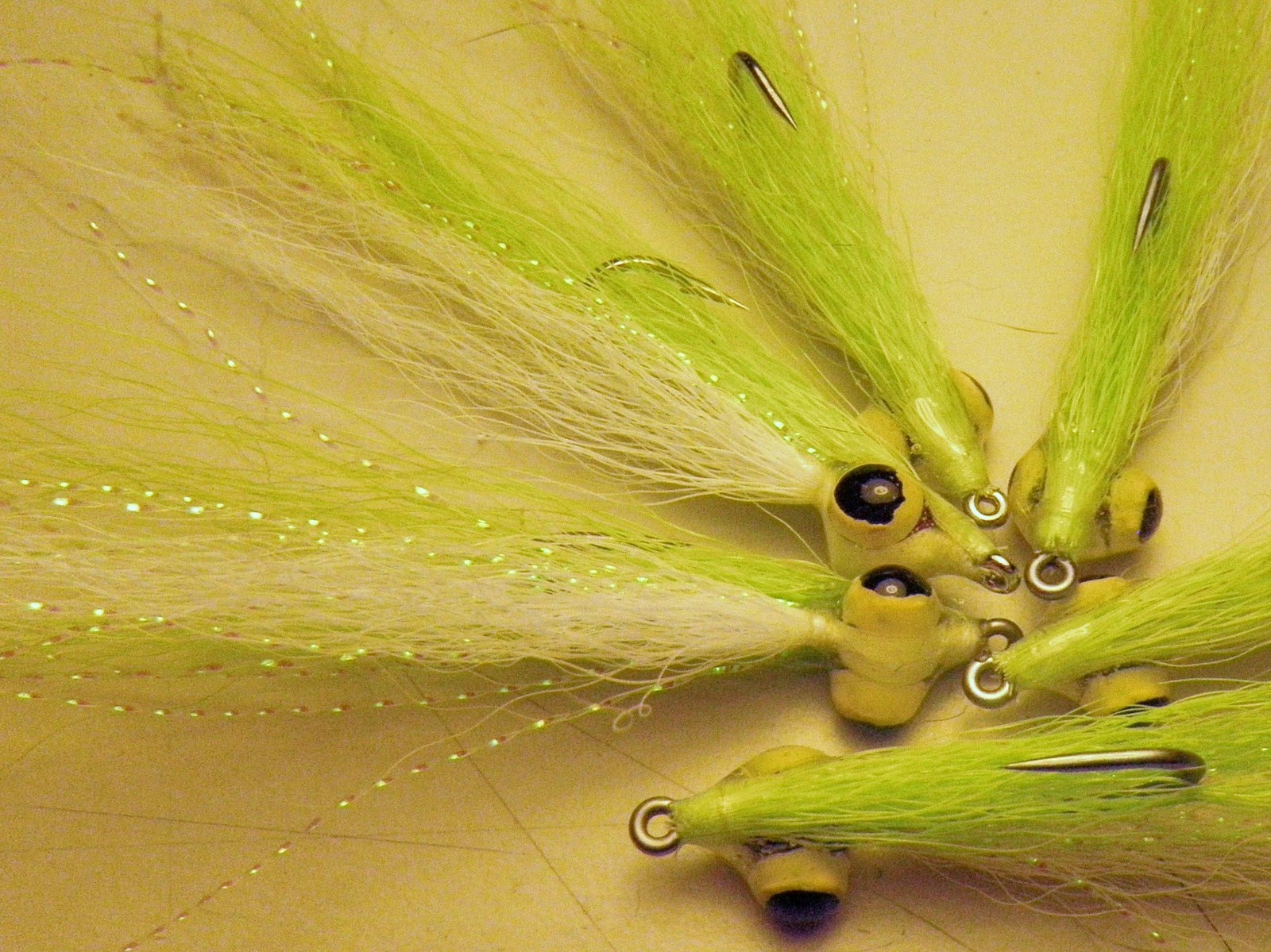
Yea, Clouser minnows. I know, big surprise right? There are few places in the world where these flies don't work so I would be remiss in my duties if I didn't send a variety with Marty to go down there. And chartreuse and white is the classic color. Plenty more of these coming in a wide variety of colors and materials too!


Some nice rabbit strip tarpon flies. I saw this pattern in a magazine a couple of years ago. It was rabbit strip in the back and wool in the front. I love the Hareline Sculpin Wool- great stuff to work with and it looks great in the water. It catches fish too! So I tied up these tarpon bunnies on some 3/0 Gamakatsu  Live Bait hooks. It is a stout hook and wickedly sharp. Hopefully that will penetrate the mouth of those brutes fairly easily! The weight of the hook combined with the materials should make for a cool neutrally boyant fly.... Let's see what the field tester says about that!

5/0 Crease flies
I have been having a lot of fun with Crease Flies too. I did them in a couple of different sizes thinking that they could be used for peacocks, snook, reds, small tarpon... lots of things. When I tie them I get to play with epoxy too! I think before too long I will post up how I do epoxy and maybe some instructions for making your own epoxy wheel pretty inexpensively. If anyone is interested that is....

More stuff coming soon!


2/0 Creasers

Wednesday, December 15, 2010

GASS BAG- the Primitive Post

Well, yes, sometimes that is exactly what I am (especially after certain meals).... but what I am referring to are the Gar Anglers Sporting Society and the Bowfin Anglers Group. Yes, it is true that there are indeed websites catering to those of us who have an unnatural inclination toward the primitive fishes swimming in our local waters! Lake Champlain is the easternmost natural distribution for both the longnose gar (Lepisosteus osseus) and the bowfin (Amia calva) and has impressive populations of both species. 
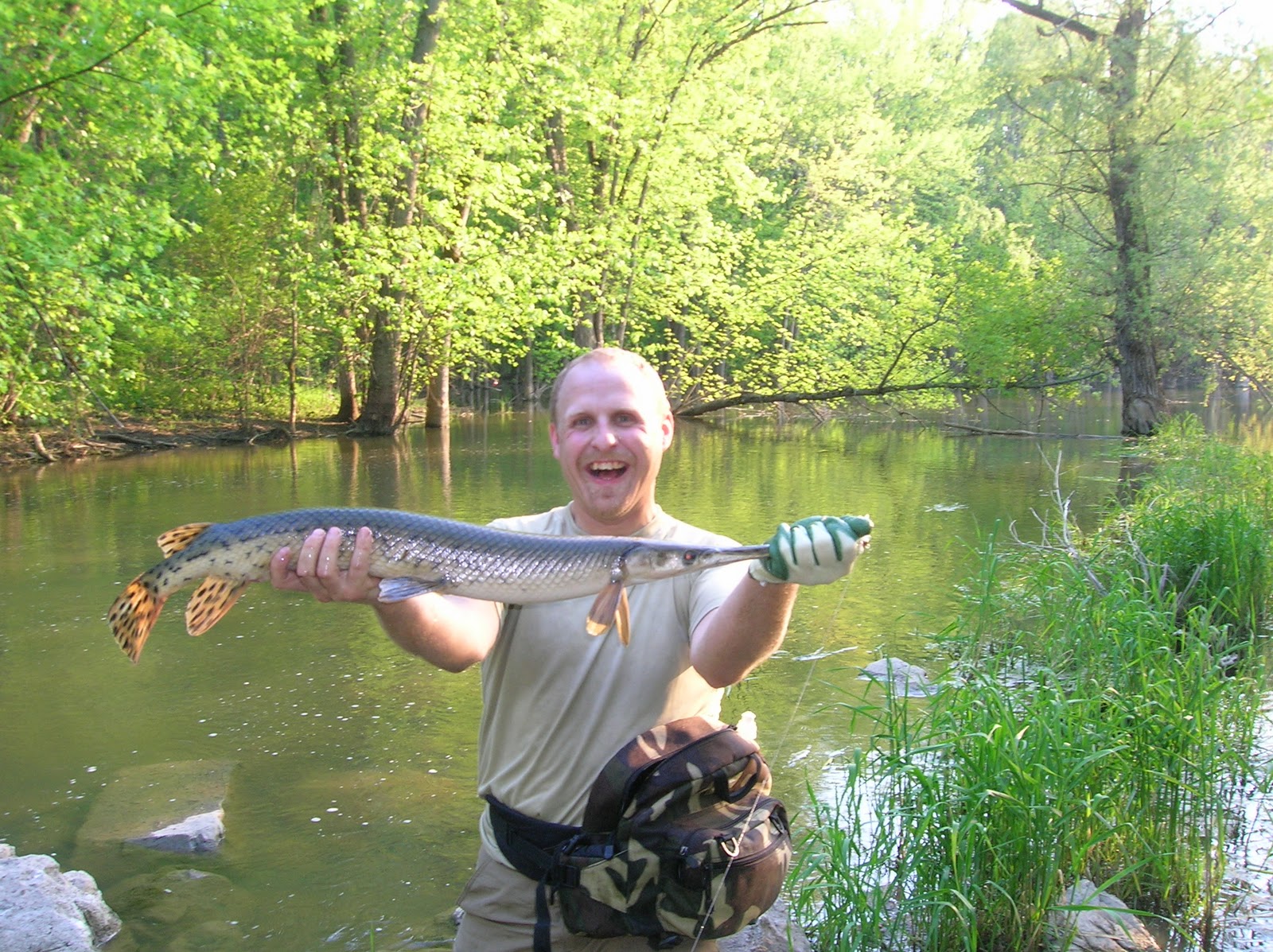
A nice gar during the spawn
The longnose gar is a fun fish to target. They get big, are easy to see in the water, and will readily take a well presented fly. I fish for them from May until September using rope flies on 8 to 10 wt outfits. A few years back Lawrence Pyne asked me to take him out to fish gar and film it for Vermont Public Television. We got a few nice fish in some tough conditions and the show was a hit (and I will put up a link as soon as VPT has the show back on their website). I don't want to give away all my gar secrets, but it does take some practice to be successful. A gar fly is semi-hookless (here in VT there has to be a hook point so I use size 20 dry fly hooks in the body of the fly) and if you set the hook, you lose the fish! 
Close up of the gar's mouth
The longnose gar is a Mississippi drainage fish that likely entered Lake Champlain via the Great Lakes then the St. Lawrence after the last glacial period. The environs of Champlain were very conducive to this primitive fish- providing many shallow, weedy backwater bays and slow moving rivers that these fish love. The gar was well known to the Abnaki who used its scales as arrowheads. Samuel de Champlain definitely saw them and wrote in his journal (this has been taken as early evidence of "Champ"):
"... there is one [fish] called by the natives 'Chaousarou', which is of various lengths; but the largest of them, as these tribes have told me, are from eight to ten feet long. I have seen some five feet long, which were as big as my thigh, and had a head as large as my two fists, with a snout two feet and a half long, and a double row of very sharp, dangerous teeth. Its body has a good deal the shape of the pike; but it is protected by scales of a silvery gray colour and so strong that a dagger could not pierce them."Just awesome fish. 
Master Class bowfin on Lake Champlain
The bowfin is the last of its kind. The family Amiiade  is well represented in the fossil record from all around the world from as early as the Jurassic Period. Just think, at one point there was a bowfin species that reached 8 feet long. If there were a fish like that in Champlain, I don't think I would be fishing out of a canoe let alone wet wade! Eastern North America is the last holdout for this primitive family of fishes. Characterized by a gular plate (throat plate), slightly heterocercal tail (similar to a shark, but less pronounced), and its namesake long dorsal fin. These predators love shallow weedy wetlands and feed on pretty much anything that gets in its way, although they seem to have a preference for aquatic crustaceans.
Look at the teeth on that puppy!
Angling for the bowfin on Lake Champlain is a relatively simple afair. They take a variety of flies, are easily sight fished, and put up a great fight. The weedy environment that they live in often requires a fairly heavy tippet on an 8 wt rod. There are times however that a 6 wt rod and lighter tippet can make this angling a whole lot more fun. It is not too difficult to get a take, but getting a good hookset in their bony mouth can be tough. A really good hook makes all the difference in this regard. I put many anglers on Master Class bowfin this year. As a matter of fact the bowfin is the most numerous fish species in the Master Angler Program largely because of me.

Great fish on a 6wt!

To my knowledge I am the only successful fly fising gar guide in Vermont. (another guide service does advertize gar as a target but no one in that guide service has yet to catch one- truth in advertizing???). Along with the gar, I brought guiding for bowfin on the fly on Lake Champlain to Vermont. I know I am not the only guide who does this, but in all honesty I taught most of the other guides how to do it. I will have gar and bowfin flies for sale on my website shortly for those of you who might be interested and I will definitely be guiding for them in this upcoming season. Please get in touch with me if you are interested- I would love to help you chase down some primitive fish!

Sunday, December 12, 2010

Early Winter Fishin' (and How to Be Comfortable Doing It)

I keep trying to get over to the Salmon River in Pulaski to fish for steelhead but plans just keep falling through. That's alright though, it has let me get out and do some fishing on a couple of rivers in Vermont that are still open. There are definitely a few great spots to fish in the winter in Vermont if you know the when and where. Unfortunately I am not going to tell you the where. Time to do your own research. I don't want to be labelled as one of those "fish and tell" guys. I can't think of anything worse than going to one of your favorite spots and having a ton of people there (or obvious signs that a lot of people have been fishing there) because someone has told everyone online exactly where to go and exactly what to do when you get there. There are definitely a few formerly great spots that have been systematically ruined by someone doing just that. But I digress.... on to winter fishin'!

I have been fly fishing in the winter months pretty much right from the time I first started fishing in college. I was very fortunate to have had  a river that was legal to fish in the winter within walking distance from where I lived. I took full advantage of that. And I caught my fair share of landlocked salmon and brown trout too. During that time I learned a thing or two about being warm and safe while fishing in the winter months. I have been amazed (and shocked) at some of the people I have fished with in cold conditions- a total lack of preparedness by people who should know better. Cotton kills folks. Plain and simple. Wet cotton holds less heat than air does. It wicks heat away from your body. If a guide puts on his waders with jeans underneath, you gotta wonder if he knows what he is doing....

Well here is my system that works out pretty well. I start with a good pair of synthetic underwear (coincidentally, I wear synthetic undies for fishing all year. So much more comfy and it eliminates chafe). I have pictures for most of the layers, but I spared you all the horror of viewing my underwear. Breathe a sigh of relief now. 
Base Layer
 The base layer is your key to comfort during a day of fishing. Good liner socks first. Lots of good ones out there- just make sure that they are a pair that will wick moisture away from your feet. That helps keep your toes toasty. Choose long underwear for your legs according to how mobile you wil be. If you plan on walking a lot then don't wear a super heavy pair of Merino woolies- lighter polypropyline will be much better. The reason for this is to eliminate sweat and over-heating. Sweat = wet which in turn = uncomfortable. Choose a good base layer for your top on the same principle. There are a lot of really good synthetic base layers out there right now and I don't think the brand matters. 
Second layer
 Next you want your main pair of socks. I wore some classic VT wool socks yesterday (seen on the left in the photo in red/grey/white). They worked out pretty well for me. The pair on the right, the olive drab colored ones are what I wear most of the time. They are kick ass socks that the military wears made out of Merino wool right here in Northfield, VT by Cabot Hosiery. I love their socks! If you haven't tried any Darn Tough socks, you really want to. I have a few pairs that are a couple of years old that look the same as the day I bought them. And I fish hard in them. Add to that a pair of fleece pants. I really like the ones with elastic cuffs at the bottom so they don't ride up when you pull on your waders. Then on top I wear a light or mid weight fleece shirt.
Top Layer
 To finish things off I put on a nice top layer. I have this totally sweet Ex Officio sweater that I wear all the time- it is really warm and cozy- that I put on as my final layer. I love their gear. I have quite a bit of it and totally recommend it. A bit pricey, but you get what you pay for! A wool sweater works very well too. Or a heavier weight fleece. I have been wearing a Buff around my neck when I fish and it really helps keep you a lot more comfortable in the winter time. Amazing how much heat you lose around your neck... plus you can pull it over your mouth and nose if your fishing buddy has the nasty farts... A good hat should top it off. Beth came home with this stupid looking camo baseball cap that she got at a yard sale this past summer. I laughed at it. The thing had these flaps that came down over your ears and it was lined. I laugh no more. That hat is da bomb! I look goofy (alright, more goofy than normal) but I stay warm. If your sweetheart has not found one of these at a yard sale, a winter hat over your ball cap works pretty darn well too. But wear a hat. Huge heat loss from the top of your head otherwise. 
Outer Shell
  The last line of defense against the cold is your outer shell. I have been winter fishing while wearing breathable waders for about 10 years now. So much more comfortable than neoprenes and without the nasty sweat factor. Every time I wore neoprenes I ended up feeling so clammy at the end of the day. Breathable waders = Bivalve Begone! (clams are bivalves, get it???  oh nevermind). Make sure you have good fitting boots too. Ones that fit your heaviest socks. If your boots are too tight your feet WILL get cold. If they are too loose, then you will slide around, have traction issues and maybe end up with blisters. Just get the right size wading boot and you will be all set. The last thing you are going to want is a good wading jacket. This will keep out the wind and the rain and the sleet and the freezing rain and the hail...... Seriously a good wading jacket is worth its weight in gold. If you get one with plenty of pockets you might even be able to eliminate wearing a vest or a pack. You don't need a lot of gear to fish in the winter so why bog yourself down?

Now that you are all properly layered up you can adjust during the day as the conditions call for. Yesterday I was overheating pretty quickly. It was in the 30's and I didn't need quite as much on. I took off my favorite sweater and I was good. It won't take long to figure out what you need to do to stay comfortable. Sometimes just zipping or unzipping your wading jacket will help a lot. Taking off your hat while you walk will help keep you from overheating. A good pair of fleece gloves is a really nice thing for your hands. Those little handwarmer packs are wonderful to defrost cold fingers too.

So how did I do on the water yesterday?  You will have to read the post tomorrow to find out!

Saturday, December 4, 2010

Drew’s Top 10 Dream Fly Fishing Freshwater Destinations Part 2

And now, what you have all been waiting for, my top 5 dream destinations for freshwater fly fishing…. (and there was much rejoicing)… 
Yikes!
#5 Zambezi River, Central Africa. Big fish with gigantic teeth. Hard to hook. Acrobatic fighters. The African Tigerfish. Those teeth can take down small Nile crocodiles (and do). Oh yea, big Nile crocs make this a no wade fishery for sure. Well, not unless you coat yourself in ketchup and mustard before you head in (crocs appreciate condiments). Boga Grips are a must for these fish and it probably goes without saying that wire leaders are in use. 8-9wt rods with shooting heads for 20+ lb fish. The Congo River sports a Goliath Tigerfish that tops out around 100 lbs…. hmmmm… maybe the Congo instead of the Zambezi…. Let’s not forget all the other fish there too- Clarias catfish, barbell, tilapia, Haplochromine cichlids, Cornish Jack, mormyrid fish (literally shocking fish!)… This is an oddball specialist’s African dream indeed!
Now that is a trout!
 #4 Mongolia- Alright salmonid fans, here you go: Taimen!!! A trout (well technically char) that you use can use musky flies and gear for. Just what I am looking for. This fish is the largest salmonid in the world- the biggest on record was about 230 lbs, but on hook and line it is closer to 100 lbs. Get your Mongol herdsman guide to climb a tree and spot one in the river for you to cast at. As long as he doesn’t throw out a prairie dog on a treble hook with a rope for a line to catch it for dinner…. Of course this is not the only fish in town. 
A pike I would love to catch....
 The spotted pike (Esox reichertii- the only member of the Esox family not found in North America) can be found in slower waters in the same river systems. Throw in lenok and Amur trout (both trout in the genus Brachymystax), grayling and the asp (a large cyprinid- minnow for you less Latin minded folks), you have a pretty interesting fishery to play around in. Couple that all with a largely roadless area, dangerous terrain, migratory habits of the taimen and the chance encounter with the Almas (the Mongolian sasquatch) and you have one hell of an adventurous trip ahead of you. 
Tarpon? Carp? nope... mahseer!
 #3 Indian Himalayas. The majesty of the highest mountain chain in the world holds a fish that has fascinated me for years- the mahseer. The steep, fast moving mountain rivers here hold this carp-like cyprinid which can reach up to 100lbs. With scales like a tarpon, Fu Manchu mustache, a trapdoor mouth, a brilliant gold coloration and a super cool streamer coming off their dorsal fin these are wicked looking fish! Totally tattoo worthy! (if I catch one I will get ink to celebrate it). This is a fish that definitely has the potential to get you down to the last bit of your backing and chasing one down a steep, boulder strewn river is just asking for a broken neck. Sounds like fun to me! Of course, this is not the only fish I want to target here either.
That's a nice cat!
How about that for a set of choppers?

How about a fish that gets over 6 feet long, 150 pounds, has recurved teeth like a shark, and has possibly consumed people? To make it even more cool, it is a catfish! The Goonch Cat. After seeing this fish on River Monsters and seeing how it hangs at the tail out of pools (clear water for sight fishing!) I want to get one- really badly. The shot of those fish right at the tail out had me thinking about a 9 wt spey rod with a fast sink tip and a big bunny fly…. Think how awesome that is, a big cat on the fly and one you have to use a wire leader for! BRILLIANT! There are also snow trout (really a cyprinid) and some brown trout left over from the British Empire days to toy around with. Anyone else for some homemade curry and some bloody big fish?
Such a classic picture..
#2 East Texas- As a kid I spent a lot of time looking at this great book my dad had called Fish and Fishing. There was a picture in there of this guy wearing a pith helmet with a steel rod doubled over with a cable for a line dragging this humungous fish up onto the bank and his buddy has it gaffed. My brother and I always wondered just what it was- it looked like it could be an alligator not a fish. Now I know that fish is the alligator gar. This is the fish that I have to say claims my most desired fish to catch spot right now. 
Now that is a lot of fish! Thanks Mustad for the pic!
 This is one of the largest fish in freshwater in North America. They can get up to about 9 feet long, over 200 lbs. They are brutes! Huge scales, huge teeth, tremendously ugly and fight like hell. Custom made for the ol’ DP indeed! East Texas is the place to find this beast. There are still good numbers of ‘gator gar in the Trinity River and other river complexes in the forested eastern part of the Lone Star State. Using some huge streamers on 10 to 12 wt rods with heavy tippet and a wire leader might bring one of these behemoths to the boat. Get it in the boat and watch out- its thrashing could break your leg like a toothpick. Like the other locations this is not the only fish to be caught- longnose gar, bass, drum and others are also available and it is all in the heart of Texas sasquatch territory (seriously). I certainly would not hesitate to cast at one of the big longnose gar- the current world record of 50lb 5 oz came from the Trinity in the 50’s. Things ARE bigger in Texas….

And now, for the final, most thrilling dream location for me:
Major league watershed!
Gorgeous male peacock with a small nuchal hump
#1 The Amazon. The center of freshwater fish diversity in the world. 3000 fish species described so far and it is estimated that there could be another 3000 left to discover. One of the biggest draws for anglers here is the peacock bass. This is a diverse group of fish in the genus Cichla- some of the largest cichlids in the world. Beautiful colors, crazy rod breaking fights, and the males sport a weird nuchal hump on their heads during the spawn. These things are so gorgeous that I might even mimic Jimmy Houston and give one a kiss. Then there is the arowana- the monkey fish- a popular aquarium fish that readily jumps out of the water for insects or other meals. And its larger cousin the arapaima- one of the largest primary division freshwater fish in the world (that means it lives exclusively in freshwater). This is a true giant capable of reaching lengths of over 10 feet and 400 lbs. Also called the pirarucu, it surfaces to breathe air from time to time. They will take flies.
Arapaima- an average fish!
So will some of the large catfish there. When I say large, I mean 4-8 foot fish. Yea, f-ing big. Don’t know if the electric eel will take a fly, but I am willing to give it a try as long as I have a native guide to gaff it just like Larry Dahlberg did. So many other fish to catch too: multiple species of piranha, cichlids of all shapes and sizes, lots of different cyprinids, smaller catfishes, and on and on. A few other fish that are possible are freshwater drum (different than the North American version), pacu, freshwater stingrays, pike characins, and the toothy traĆ­ra. I almost forgot the payara- the vampire fish. This thing sports huge lower canines that fit into sheaths in their upper mouth. Getting up to 30 lbs, in fast water and fighting hard, they are a fish made for me! With all these fish to fish for it seems like I might have to spend at least a month there… two would be better.
There is one fish I don’t want to encounter though…. The candiru. This tiny little catfish will follow a urine stream put to its source- definitely not a good thing for a wading angler! Perhaps the sheath that I got from the New Guinea natives would help out……
Guess where this came from?
So that is my list of my top 10 destinations worldwide for freshwater fly fishing. If I ever hit the lottery I will be visiting them all. There are a few that are easily within reach- Minnesota and Texas-and I hope it won’t be too long before I get to them. This is by no means a comprehensive list either… there are plenty of other places I would love to fish- Central America for a variety of cichlids found there, the Orinoco Basin in South America (very similar to the Amazon but with a large endemic crocodile!), the Nile River for Nile Perch, Austria for Hucho hucho and wild browns, Wels catfish somewhere in Europe, Lakes Malawi and Tanganyika in East Africa for the diversity of cichlids there, on and on and on. Basically anywhere there are fish I will fish for them.

Thursday, November 11, 2010

Hooks

I love hooks. Such a variety out there to work with. I will go so far as to say that they are a critical element in the success of a day on the water. From that initial take, to the fight then on to landing the fish, the hook is an invaluable tool to any angler. This makes hook choice vital to a fly tyer or even to an angler choosing what flies to purchase. 

I used to use almost any ol' hook. It didn't matter to me what it was as long as I could wrap thread and materials onto it I used it. I remember well my first lesson on the importance of a good sharp hook. It was fall of 1995 and I was fishing for landlocked salmon on the Saranac River in Plattsburgh, NY. This was the ol' salad days of salmon fishing on Lake Champlain. Lots of fish in the river and lots of big fish too (the initial sea lamprey control program had really been working well). I was getting takes on my fly patterns- which were really simple rabbit patterns- but not many fish on for long, and even fewer landed. It made me wonder what the deal was. Then I figured it out. The ol' Mustad 36890 salmon iron was my hook of choice. They were not sharp hooks. I started sharpening them before I tied on them and voila! my hook up to landed ratio went through the roof.


I still sharpen some hooks when I tie on them (I will save my pointers on properly sharpening hooks for another entry) but now I much prefer to tie with chemically sharpened hooks. All major brands of fly tying hooks now offer super sharp hooks. I have tied with Mustad Signature, Daiichi, Gamacatsu, Tiemco, and Dai-Riki many times and I love twisting my creations on all of them. I am also experiementing with some other brands like Matzuo, VMC and others. There are so many options available.


I will admit that these hooks tend to be more expensive than those that are not chemically sharpened. Personally, I am willing to spend the money on better hooks if that means that my clients, friends or I will have a greater chance of hooking and landing that bruiser we are after. And if you shop around you can usually get a good deal on the hooks you are after.

The end result of using a good sharp hook!